7 Differences Between Businesses That Get Stuck and Those That Scale
Ryan Deiss has a newborn baby, a mortgage, and a quarter million dollars in debt story. Today he runs a $200 million portfolio of seventeen companies and has sat across the table from over a thousand seven-figure business owners. He says he can usually tell within ten minutes which ones are going to make it to eight figures and which ones are going to stay exactly where they are.
The differences are not what you'd guess. They come down to seven patterns he has watched play out over and over.
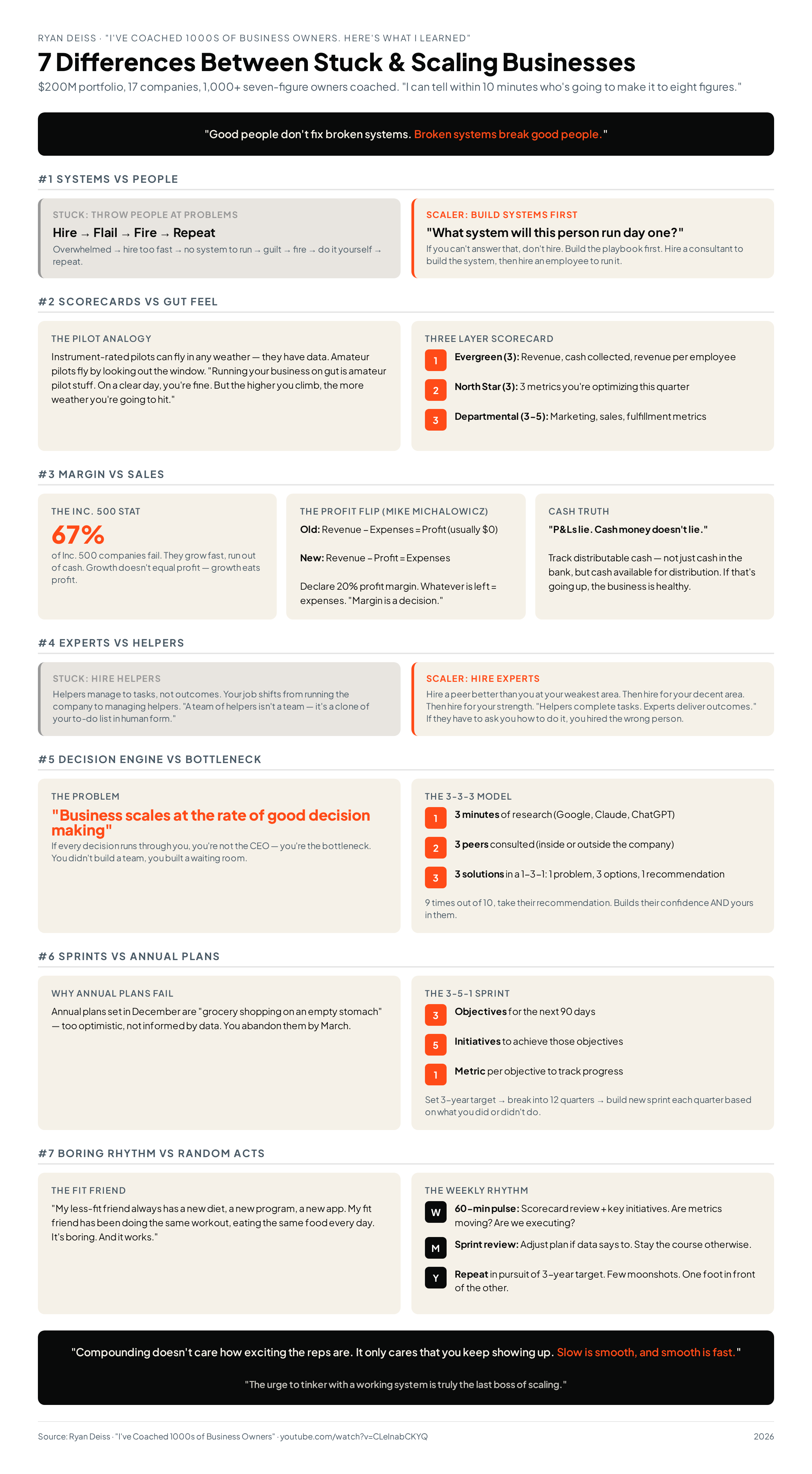
1. Stuck owners throw people at problems. Scalers build systems first.
Brute force and effort will get you to seven figures. If you can outwork everybody and care more than everybody, you can probably hit a million dollars in revenue. The problem is that playbook becomes the thing keeping you stuck.
The cycle looks like this: you get overwhelmed, hire the first person who seems competent, throw them into the problem with no system to run, watch them flounder, feel guilty because you know you set them up to fail, let them linger too long, eventually fire them, and go back to doing the work yourself. Overwhelmed, hire, flail, fire, repeat.
The fix is a single question: what system is this person going to run starting day one? If you cannot answer that, do not make the hire. Build the playbook first. If you do not know how to build the system either, hire a consultant to build it — then hire an employee to run it after the system exists.
"Good people don't fix broken systems. Broken systems break good people."
2. Stuck owners run on gut. Scalers run on scorecards.
Deiss has two pilot friends. One is instrument-rated — he can fly day and night in any weather because he has flight data. The other is an amateur who flies by looking out the window. Deiss will not fly with the amateur.
"Running your business on gut is amateur pilot stuff. On a clear day at low altitude, you're probably fine. But the higher you climb, the more weather you're going to hit."
The minimum scorecard he recommends has three layers. Layer one: three evergreen metrics — revenue, cash collected, revenue per employee. Layer two: three North Star metrics — the three numbers your team has decided to optimize for the next 90 days. Layer three: three to five departmental metrics — what your marketing, sales, and fulfillment leads say defines their success.
That is roughly a dozen numbers tracked weekly, each with an owner. Not a forty-metric dashboard nobody reads. But way better than flying blind.
3. Stuck owners chase sales. Scalers chase margin.
Inc. Magazine published a stat that should terrify anyone chasing growth: 67 percent of companies that make the Inc. 500 list of fastest-growing companies in America end up failing. They fail at a higher rate than non-Inc. 500 companies. The reason is simple — they run out of cash.
Growth is fire. Fire does not fuel itself. It consumes fuel. More people, more inventory, more ad spend, more payroll. Every new log on that fire is more cash. Growth does not equal profit. Growth eats profit.
The fix comes from Mike Michalowicz's Profit First: flip the equation. Instead of revenue minus expenses equals profit (which is usually zero), declare revenue minus profit equals expenses. Set a 20 percent profit margin target. Whatever is left is what you spend. If you cannot produce margin when you are small, you will not produce it when you are big.
"P&Ls lie. Cash money doesn't lie." Track distributable cash — not just cash in the bank, but cash available for distribution.
4. Stuck owners hire helpers. Scalers hire experts.
In the beginning, everyone hires helpers — someone to answer tickets, an office manager, a virtual assistant. These people manage to tasks, not outcomes. You give them something to do and they do it or they don't.
If all you ever do is hire helpers, your job quietly shifts from running the company to managing helpers. You built a clone of your to-do list in human form. Everything still routes through your brain.
Every business does three things: marketing, sales, and fulfillment. You are good at one, decent at another, and kind of bad at a third. The two mistakes people make are hiring a helper to cover your weakness (now two people who are bad at something are somehow supposed to be better at it together) and hiring a helper to cover your strength so you can work on your weakness (bench your best player to play your worst position).
The fix: hire a peer who is better than you at the thing you are weakest at. Not a helper. An expert who steps in, takes it over, and the business actually grows.
"Helpers complete tasks. Experts deliver outcomes. If you hired someone to do a job and they have to ask you how to do it, you hired the wrong person."
5. Stuck owners hoard decisions. Scalers build decision engines.
Business scales at the rate of good decision making. Not just good decisions — good decisions made quickly. If every decision still runs through you, you are not the CEO. You are the bottleneck. You did not build a team. You built a waiting room.
Deiss uses the 3-3-3 model. Before anyone brings him a decision, three things must happen. First: 3 minutes of research — Google it, ask Claude, ask ChatGPT. Second: talk to 3 peers, inside or outside the company. Third: bring 3 possible solutions in a 1-3-1 document — one clear statement of the problem, three researched options, and one recommendation.
Nine times out of ten, he takes their recommendation. That builds their confidence in themselves and his confidence in them. People who consistently bring solid 1-3-1s eventually earn the right to just do it without asking. That is how executives are made.
6. Stuck owners build annual plans and abandon them. Scalers run 90-day sprints.
Annual plans set in December are grocery shopping on an empty stomach — too optimistic, not informed by data, abandoned by March.
The alternative is the 3-5-1 sprint: 3 objectives for the next 90 days, 5 initiatives to achieve them, and 1 metric per objective to track progress. Set a 3-year target, break it into 12 quarters, and build a new sprint each quarter based on what you did or did not do the previous 90 days.
If you can create 24 percent year-over-year compounded growth for 3 years, you will double. That is the math.
Every week, hold a 60-minute pulse meeting: pull up the scorecard, look at key initiatives, and ask two questions. Are the metrics moving? Are we executing? Every month, do a sprint review — adjust the plan if the data says to, stay the course otherwise.
7. Stuck owners chase new tactics. Scalers run boring rhythms.
Deiss has a friend who is incredibly fit and another who is not. The less-fit friend always has a new diet, a new program, a new app. The fit friend has been doing the same workout and eating the same food every single day. It is boring. It works.
"Compounding doesn't care how exciting the reps are. It only cares that you keep showing up."
The scaling companies look boring from the outside. They are not flailing. They are not chasing. They are executing the right next thing and then the next thing. The urge to tinker with a working system is truly the last boss of scaling.
The Navy SEALs have a saying: slow is smooth, and smooth is fast. That same rule applies in business. Scaling businesses look boring from the outside, but they can go wherever they want because the work actually gets finished.
Source: Ryan Deiss — "I've Coached 1000s of Business Owners. Here's What I Learned" · Watch the full video
Working on something similar? Fastest over WhatsApp.
Message me on WhatsApp →