Alex Hormozi's Cold Email Playbook: The System Behind 50% of Gym Launch Sales
Before the books, the podcast empire, and the $100 million offers, Alex Hormozi built Gym Launch on cold outbound. When the company sold, half its sales were still coming from cold email. The company is up 45 percent since the sale, and outbound still drives over 50 percent of revenue.
He still tells beginners cold email is the first thing to learn. Not because it is easy, but because it teaches you the hardest skill in sales: convincing someone who has never heard of you to pay attention.
I pulled his entire cold email playbook from years of podcasts, Q&As, and one masterclass most people have never seen. Here is what he actually teaches.
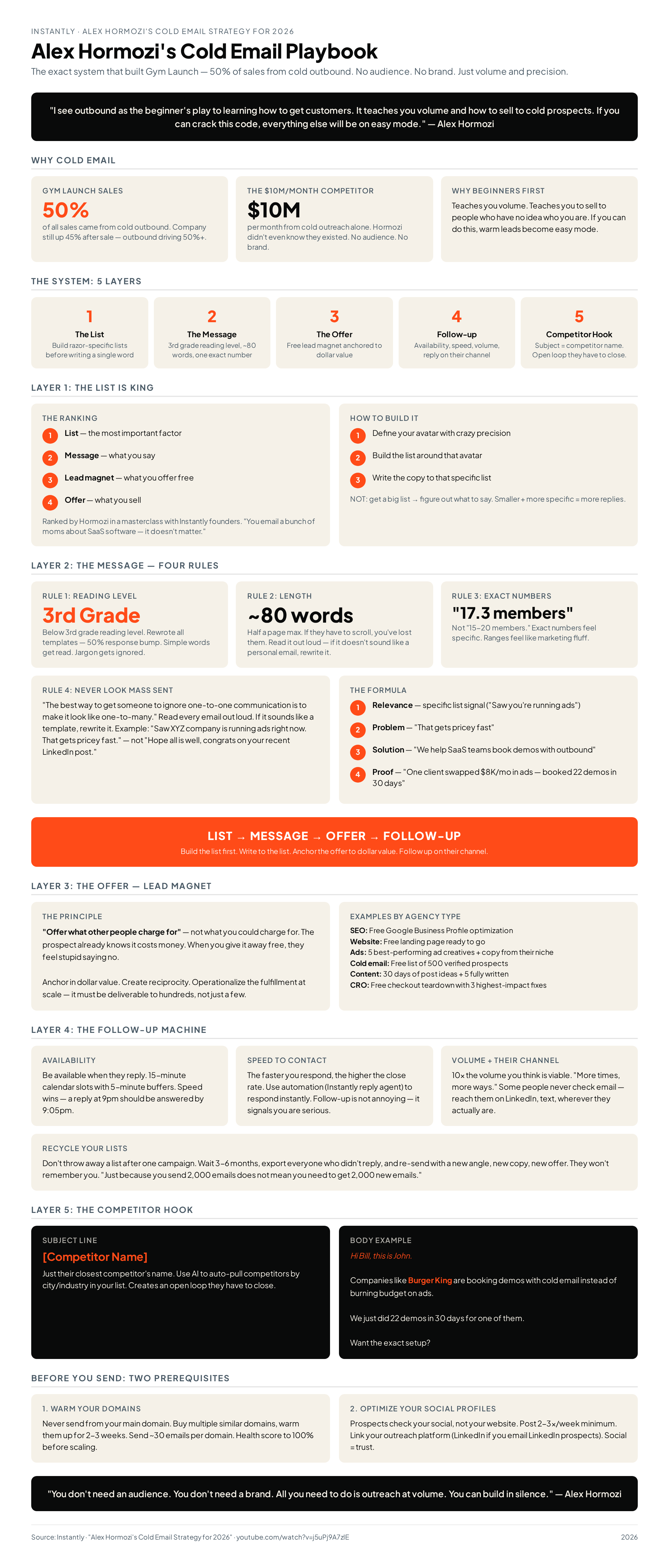
The list is king
Hormozi ranked the four elements of cold email in a masterclass with the Instantly founders. The ranking surprised me.
List is number one. Above the message. Above the lead magnet. Above the offer. Above everything else.
"You email a bunch of moms and you're talking about SaaS software — it really doesn't matter."
His logic is simple. If you have the perfect email sent to the wrong person, how good is that email? It is worthless. But if you have a mediocre email sent to exactly the right person, you still have a chance.
The practical order is: define your avatar with precision, build the list around that avatar, then write the copy to that specific list. Do not do it backwards. Do not buy a list of 100,000 real estate agents and blast the same message to everyone. The smaller and more specific the list, the more replies you get.
Two constraints for writing the email
Hormozi does not teach email templates. He teaches four rules.
Rule 1: third grade reading level.
He rewrote every email template in his company to below a third grade reading level. The result was a 50 percent increase in response rate. Not from better copywriting. From simpler language.
Simple words get read. Jargon gets ignored. If your email has to be "understood," it is already too complex.
Rule 2: half a page, roughly 80 words.
Short emails get read. Long emails get archived. If they have to scroll, you have lost them. Read every email out loud before sending. If it does not sound like a personal email to one person, rewrite it.
Rule 3: one exact number instead of a vague range.
"17.3 members" outperforms "15 to 20 members." Exact numbers are believable because they feel specific. Ranges feel like marketing fluff.
Rule 4: never look mass sent.
"The best way to get someone to ignore one-to-one communication is to make it look like one-to-many." That is Hormozi's rule. The second your email smells like a blast, it gets deleted.
The formula he teaches: start with a relevance line tied to your specific list ("Saw XYZ company is running ads right now"), name the problem ("That gets pricey fast"), offer the solution ("We help SaaS teams book demos with outbound"), and add one specific proof point ("One client swapped $8,000 a month in ads and booked 22 demos in 30 days").
The offer that multiplies replies
The offer is not your product. The offer is a free lead magnet anchored to real dollar value. Hormozi's exact words: "Offer what other people charge for." Not what you could charge for — what other people already charge for. The prospect already has a price anchor in their head. When you give it away for free, they feel stupid saying no.
The example Hormozi gives: "We just did 22 demos in 30 days for one of your competitors. Want the exact setup?"
That sentence does three things. It references a competitor (social proof). It names a specific result (22 demos in 30 days). And it offers the exact system for free (value).
Here are concrete examples he gives for different agency types: a free Google Business Profile optimization for SEO agencies, a free landing page for website agencies, five best-performing ad creatives plus copy for ads agencies, a free list of 500 verified prospects for cold email agencies, 30 days of post ideas plus five fully written for content agencies, and a free checkout teardown with three highest-impact fixes for CRO agencies.
The key requirement: you must be able to deliver this lead magnet at scale. It cannot be a custom consultation for every prospect. It has to be something you can operationalize for hundreds of people.
The follow-up machine
Hormozi identified four levers for follow-up that most people ignore.
Availability. Be available when they reply. A response at 9pm should be answered by 9:05pm. Not the next morning. Speed signals that you are serious.
Speed to contact. The faster you respond to a warm lead, the higher your close rate. Use automation to respond instantly. Do not let leads cool down.
Volume. "Ten x the volume you think is viable." Most people send 50 emails a week and wonder why nothing works. The number should make you uncomfortable. If it feels like too much, it is probably about right.
Reply on their channel. Hormozi put it bluntly: "I will never respond to an email. I just don't respond. But I respond to texts. If a sales guy is trying to email me, I'm never going to respond. I wouldn't respond to my own mother."
Some people live on email. Some people live on LinkedIn. Some people live on text. Reach them where they actually are, not where it is convenient for you.
And one more thing most people miss: recycle your lists. Do not throw away a list after one campaign. Wait three to six months, export everyone who did not reply, and re-send with a new angle, new copy, and a new offer. They will not remember you. "Just because you send 2,000 emails does not mean you need to get 2,000 new emails."
The competitor hook
This is Hormozi's favorite outreach play. He calls it the best cold email he has ever seen.
The original was a voicemail script: "Hey, this is John. I'm calling about Burger King. Give me a call back."
If you are calling McDonald's, you mention Burger King. Completely open hook. The recipient has to call back because they want to know what their competitor is doing.
Translated to cold email:
Subject line: Their closest competitor's name. Use AI to auto-pull competitors by city or industry in your prospect list.
Body: "Hi Bill, this is John. Companies like Burger King are booking demos with cold email instead of burning budget on ads. We just did 22 demos in 30 days for one of them. Want the exact setup?"
The subject line creates an open loop. The body references a competitor, names a specific result, and offers the system for free. It is short, specific, and impossible to ignore.
Before you send anything
Two prerequisites that most beginners skip.
Warm your domains. Never send cold email from your main domain. Buy multiple similar domains, set up email accounts on each, and warm them up for two to three weeks before sending at scale. Send roughly 30 emails per domain per day. Monitor your health score and wait until it reaches 100 percent before scaling.
Optimize your social profiles. When someone receives your cold email, the first thing they do is check your social profile. Not your website. Your LinkedIn, your Instagram, whatever channel you are reaching out from. Post two to three times a week minimum. Make sure your profile looks like someone worth replying to.
Cold email gets them to look at you. Your social profile decides whether they reply.
What this means for builders
Hormozi's playbook is not complicated. It is five layers: list, message, offer, follow-up, competitor hook. The hard part is not knowing the system. The hard part is doing the volume.
A company in his space was doing $10 million a month from cold outreach, and he did not even know they existed. No audience. No brand. Just outbound at volume.
"You don't need an audience. You don't need a brand. All you need to do is outreach at volume. You can build in silence."
Source: Instantly — "Alex Hormozi's Cold Email Strategy for 2026" · Watch the full episode
Working on something similar? Fastest over WhatsApp.
Message me on WhatsApp →