Your Product Is Done. Now Build a Go-To-Market.
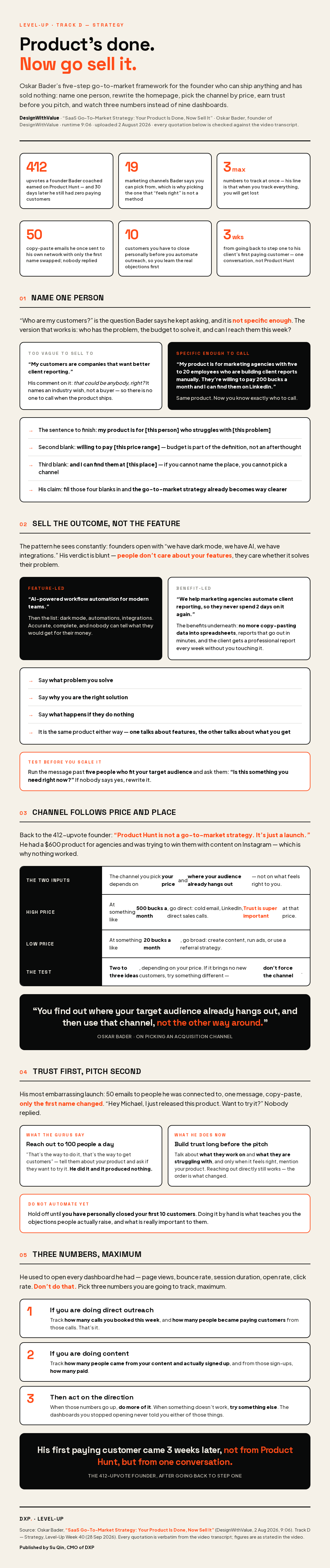
A founder Oskar Bader coached launched on Product Hunt, collected 412 upvotes, and thirty days later still had zero paying customers. The five-step fix is unglamorous: name one person, rewrite the homepage around outcomes, pick a channel by price, earn trust before you pitch, and watch three numbers instead of nine dashboards.
A founder I was coaching launched on Product Hunt and got 412 upvotes. He thought he had made it. Thirty days later he had zero paying customers. Zero.
That is the opening of Oskar Bader's nine-minute teardown on go-to-market strategy, and it lands because the ending is worse than the beginning. Upvotes are applause, and applause is not a distribution channel. What finally moved the needle for that founder was not a launch, a spike, or a feature. It was one conversation, three weeks after he went back to step one.
"Who are my customers?" is the wrong question
Bader's confession is that he asked it for years. It sounds logical. It is not specific enough.
The version that works has three conditions and a place:
Who has the problem, the budget to solve it, and can I reach them this week?
Write it as a sentence with four blanks. My product is for [this person] who struggles with [this problem], is willing to pay [this price range], and I can find them at [this place].
Watch what happens when someone fills it in sloppily. "My customers are companies that want better client reporting." That could be anybody, so there is nobody to call on Monday morning. Now the same product, filled in: my product is for marketing agencies with five to 20 employees who are building client reports manually, they will pay 200 bucks a month, and I can find them on LinkedIn.
Nothing about the software changed. The sentence changed, and with it the entire go-to-market.
Stop selling the ingredients
Founders open with "we have dark mode, we have AI, we have integrations," and he has watched it kill conversions over and over. People do not care about your features. They care whether the thing solves their problem.
Three things have to be in the message: what problem you solve, why you are the right solution, and what happens if they do nothing. The third one is almost never there, and it is the one that creates urgency.
Instead of "AI-powered workflow automation for modern teams," try "we help marketing agencies automate client reporting, so they never spend two days on it again."
Then test it before you build anything around it. Show the message to five people who fit your target audience and ask them one question: is this something you need right now? If nobody says yes, rewrite it.
The channel is downstream of the price
This is where the 412-upvote founder went wrong. He was selling a $600 product to agencies and trying to win them with content on Instagram. The channel did not fail because Instagram is bad. It failed because it was picked by vibe.
Price is the first input. Sell something at $500 a month and you go direct — cold email, LinkedIn, sales calls. Sell at $20 a month and going direct will cost more than the deal is worth, so you go broad: content, ads, referrals.
Where they already hang out is the second: you find out where your target audience already hangs out, and then use that channel, not the other way around.
Test two or three ideas for your price band. If you get no new customers, try something different and do not force the channel.
Trust first, pitch second
Bader's most embarrassing story is his most useful. He sent 50 emails to people he was connected to. One message, copy-paste, only the first name swapped: "Hey Michael, I just released this product. Want to try it?" Nobody replied.
The gurus told him that was the method — reach out to 100 people a day. What they leave out is the precondition. You have to build trust long before you show anyone the product: talk about what they work on, what they are struggling with, and only mention yours when it feels right.
The other half of that advice is a hard stop on tooling. Do not automate it yet — not until you have personally closed your first 10 customers. Doing it by hand is the only way to hear the real objections.
Three numbers, maximum
His instruction is blunt: don't track everything. When you track everything you get lost.
Pick three numbers. If you are doing direct outreach: how many calls you booked this week, and how many of those calls became paying customers. If you are doing content: how many people came from your content and actually signed up, and of those sign-ups, how many paid.
The point is not the metrics. It is that the two answers tell you what to do next.
The part that actually happened
Back to the founder with 412 upvotes. They went to step one. Defined who his customers are. Rewrote the message. Picked one marketing channel. Started reaching out to people one by one.
His first paying customer came three weeks later. Not from Product Hunt. From one conversation.
Shipping was the easy half — you controlled every variable. Selling is the half where someone else gets to decide, and the only leverage you have is saying one specific thing to one specific person about one specific problem.
Start with the sentence. Fill in the four blanks. Everything after that gets easier.
Source: Oskar Bader, "SaaS Go-To-Market Strategy: Your Product Is Done, Now Sell It", DesignWithValue, 2 August 2026 (9:06). All quotations verified against the video transcript. Published by Su Qin, CMO of DXP.
Working on something similar? Fastest over WhatsApp.
Message me on WhatsApp →