The State of Startups in 2026: What Y Combinator Is Seeing
Y Combinator works with thousands of founders every year. That gives them a front-row seat to shifts before they hit the mainstream. This week, Garry Tan, Jared Friedman, Diana Hu, and Harj Taggar shared what they are seeing on The Lightcone — and the data is striking.
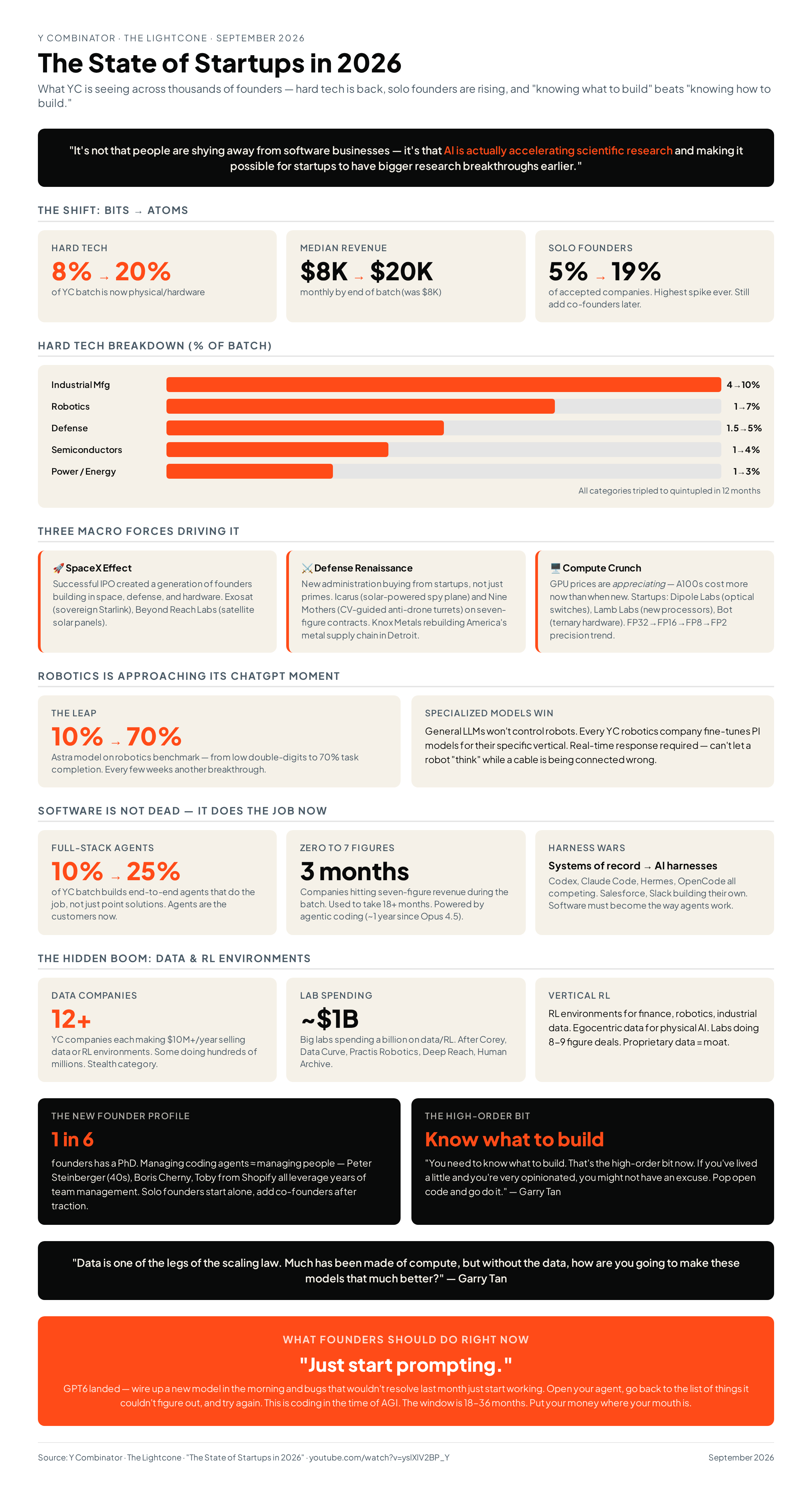
I watched the full episode, pulled the numbers, and built an infographic. Here is what stood out.
Startups are moving from bits to atoms
Hard tech companies — robotics, defense, manufacturing, semiconductors, power infrastructure — now make up 20% of YC batches. A year ago, that number was 8%.
This is not a rounding error. Robotics went from 1% to 7% of the batch. Industrial manufacturing went from 4% to 10%. Defense went from 1.5% to 5%. Semiconductors and power infrastructure each tripled or quintupled.
The world is building things again. And the venture capital ecosystem, which spent a decade funding B2B SaaS because it was more profitable, is finally coming back to its roots.
Why now? Three forces
The SpaceX effect. SpaceX's IPO created a generation of founders who want to build in space and defense. YC is funding companies like Exosat (sovereign Starlink) and Beyond Reach Labs (solar panels for satellites).
The defense renaissance. The current US administration is buying from startups, not just the big defense primes. Icarus is building a solar-powered surveillance plane. Nine Mothers is building computer-vision-guided anti-drone turrets for special forces. Both already have seven-figure contracts.
The compute crunch. Nvidia GPUs are actually appreciating in price. An A100 costs more now than when it was new, because demand outstrips supply. Startups are building alternative silicon (Lamb Labs, Bot), optical data center switches (Dipole Labs), and power infrastructure to feed the AI buildout.
AI is making hard tech easier, not harder
This is the part most people miss. Hard tech used to be hard because you needed supply chains, software engineers, and massive capital. Now, code generation means a small team can move at the speed that used to require hundreds of engineers.
Jared Friedman put it well: three or four years ago, top-tier software engineering was one of the limiting reagents for full-stack hardware. That is less true now. You still need great engineers, but you do not need to hire a thousand of them to compete with Google or Meta.
And the bull case is even stronger: AI is not just helping startups build faster. It is accelerating scientific research itself, making it possible for startups to have bigger research breakthroughs earlier.
Software is not dead. It is transforming.
The narrative that "SaaS is dead" is wrong. What is true is that software is changing shape.
The percentage of YC companies building full-stack, end-to-end agents (not just point solutions) went from 10% to 25% of the batch. These are companies where the agent does the actual job — insurance brokering, clinical intake, medical billing — not just tracks it.
This is where the revenue growth is coming from. The median YC company now reaches $20,000 in monthly revenue by the end of the batch. A year ago, that number was $8,000. Some companies are going from zero to seven figures in three months. That used to take eighteen months or more.
The reason is simple: people want software that does the job, not software that helps them do the job. If an agent can automate the full workflow, companies will pay more for it than they would for a system of record that just tracks the work.
The harness wars
Garry Tan made an interesting observation: systems of record — Salesforce, Slack, and their peers — are at a crossroads. They either become AI harnesses (the place where agents actually do work), or they get disintermediated by MCP and lose their data moat.
We are at the beginning of what he calls "the harness wars." Codex, Claude Code, Hermes, OpenCode — they all want to be the interface where agents operate. Salesforce is building its own Slack-based harness. The companies that win this race will own the workflow, not just the data.
The hidden boom: data and RL environments
This is the category most people outside the AI industry do not know about.
More than a dozen YC companies are each making over $10 million a year selling data or reinforcement learning environments to AI labs. Some are doing hundreds of millions. The big labs are reportedly spending about a billion dollars on this, collectively.
The companies are mostly stealth — they have no incentive to talk about how well they are doing. But the business is real, and it is growing fast. YC funded Scale back in 2016 when this was not even a category. Now it is one of the biggest revenue engines in the batch.
The reasoning is straightforward: data is one of the legs of the scaling law. You can have all the compute in the world, but without the data to train on, you cannot make models better.
Robotics is approaching its ChatGPT moment
A few months ago, the Astra robotics model went from around 10% to 70% task completion on a key benchmark. That kind of leap happens once in a field, and everyone in robotics felt it.
The consensus at YC is that we are going to get the ChatGPT moment for robotics — the point where it just works — but we are not quite there yet. Every YC company using Physical Intelligence's models is fine-tuning them for their specific vertical. No one is using them out of the box.
The reason is that robotics needs real-time response. An LLM can take its time thinking. A robot connecting cables in a data center cannot pause while it figures things out. That is why specialized, fine-tuned models for specific verticals (data center cabling, warehouse picking, industrial inspection) will win over general-purpose robotics models.
Solo founders are real now
The number of solo-founded companies accepted into YC went from 5% to 19% in the last year. That is nearly one in five.
The classic startup playbook said you needed a co-founder — someone who can sell while you build, or vice versa. AI tools have changed that equation. If you can prompt well and know what to build, you can get a product to traction alone. The bar for needing a co-founder has dropped.
But here is the nuance: most successful solo founders still add co-founders later, after they have traction. The dynamic is different from the traditional "two people in a room, 50/50 split from day one." It is more like: start alone, prove the idea, then bring on partners when the company is already moving.
Experienced founders are having a resurgence
Garry Tan called it: some of the most powerful founders YC is seeing right now are in their late 30s, 40s, even 50s. They have been around the block. They know where the dragons are. They have taste.
The example he gave was Peter Steinberger — early 40s, former dev manager, worked on startups before. He got deeply into AI tooling early, tried a lot of stuff, and knew what to build. That combination of domain experience and AI fluency is unusually powerful right now.
There is a practical reason too: managing coding agents is not that different from managing people. People who have spent careers managing engineering teams — like Boris Cherny or Toby from Shopify — adapt to AI-native workflows faster than a brilliant 19-year-old who has never managed anyone. Years of experience running teams translates directly to running agent teams.
The high-order bit
The gates that used to define who could start a company — co-founder required, certain investors needed, specific credentials — are falling away. What matters now is knowing what to build.
Garry Tan's advice for founders who want to start right now:
"Just start prompting. Open up GPT-6. Go back to the list of things your agent could not figure out. Try again. It will figure it out. Every single time. What a weird moment we are in history — you wake up in the morning, wire up a new model, and things that would not work last month just start working."
The window is eighteen to thirty-six months. Maybe longer, maybe shorter. Nobody knows. But right now, coding in the age of AGI is the most leveraged thing a builder can do.
If you have been a loudmouth on the internet about what should be built, now might be the time to put your money where your mouth is.
Source: Y Combinator, The Lightcone — "The State of Startups in 2026" · Watch the full episode
Working on something similar? Fastest over WhatsApp.
Message me on WhatsApp →